Classroom: Working Together-Warm up

The first day of class I was a bit shy. I didn't know anyone. The teacher gave us a questionnaire to get to know each other. After sharing the answers with the other students, we all felt much better about talking to everyone there.
Some of the questions were a bit unusual. For example:
- Tell us one thing about yourself that you want to share with the class.
- If you were an animal, which one would you choose? Why?
- What do you expect from this class?
- Choose one student you don't know very well, add onne question to the list and and e-mail these questions to her/him.
- Answer questions about yourself from other students.
Women's Health (Smart learning)
Last week we had a very informative session on breast examination, Pap smears and pelvic floor exercises. (Sorry to any male students, but this is very important. You can learn about it and tell your girlfriends and/or wives). WOMEN'S
HEALTH IS OUR RIGHT and OUR
RESPONSIBILITY YOUR body IS THE container of your MIND & SPIRIT.
DO NOT NEGLECT IT!
 It wasn't easy to understand everything because of all the new medical words. Have a look at the leaflets the nurse gave us and visit these web sites:Breast
It was a coincidence that on the same evening we heard the news about Kylie Minogue's breast cancer.
Read the following articles, from three different sources:
Kylie has breast cancer (Sky Showbixz)Kylie Battling Cancer (Rolling Stones) Superstar Kylie Minogue diagnosed with Breast Cancer (Teen Music, About)When you finish reading all three versions of the same story, write in your blog or notes about the differences and similarities between the three. Answer these questions to help you organise your thoughts:
1. Do they present the same content, the same information?
2. Do they use photos in an honest way? Or do they manipulate them to affect our feelings?
3. What is around the article? Are they trying to sell something? Are they adding useful information?
4. Do they give serious information or just anecdotes about the singer?
5. Which article is more believable and why?
6. Do you think it's ok to talk about a famous person's medical problems? Why?
Blogs & Web Journals
You can create your own blog and use it like a web journal where you write about your learning, your English class and your feelings about it.

There are many good examples by students of all ages. Explore them (
Patrick's blog,
The Write Weblog,
The New Tanuki ,
The Image Englissh Class Weblog), and if you feel up to it, you can look at these instructions on
how to start your own blog and start writing!
Our Classroom
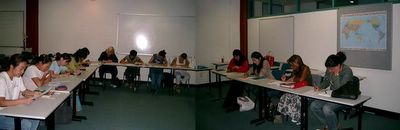
This is our classroom. We do a lot of work here. Most of it is done in groups or pair work. It is very important to participate, because for many of us this is the only chance we have of practising our English. At home we use our mother tongue. I always try to sit with a classmate from a different cultural background and language.
Have a look her at our first woork together:
Warm Up Collaborative ActivityYesterday we did pair work to practise conversations to ask for goods and services at TAFE. Go to
Simulation Game and start working on it.
TAFE SERVICES Simulation Game
Role Play & Pair workChoose one of the following roles and let your teacher know which one you've chosen. You will have to do a bit of research before starting the game.
Your teacher will tell you which student you are working with. You can communicate with that student through the chat/ email facilities in this toolbox.
The final product will be a dialogue of a TAFE services transaction.
 TAFE Bookshop
Role Play Cards: Goods and Services at the college.
STUDENT A
You are the college bookshop manager.
Answer the customer's enquiries about prices. Remember student association members have a 10% discount on some items (find out which ones). The customer wants to buy: - Macquarie Pocket Dictionary (paperback)
- Plastic A4 2-ring binders (2 styles available)
- Floppy discs
- Pens & a birthday card
- Some items you don't stock
| STUDENT B
You are the customer at the college bookshop.
You want to buy the following items:
- Macquarie Pocket Dictionary (paperback)
- Plastic A4 2-ring binders (2 styles available)
- Floppy discs
- Pens & a birthday card
- Plastic sleeves & a calculator
|
|---|
STUDENT C
You are the counsellor
Give career advice to an ESOL student who is about to finish his/her ESOL 4 class.
| STUDENT D
You are a student visiting the counsellor.
You are about to finish ESOL 4 and are not sure of what to do next. You are thinking of doing some course at TAFE and maybe later on continue onto university.
|
Topic 1 My Study Room
IntroductionBy the end of this unit you will:
Do a 'Brainstorm' to open up your ideas of what learning means for an individual.
Find out what 'type of learner you are by taking a Learning Styles Survey
You will start thinking about getting organised to improve your time mangement skills.
You will think about your goals, what you want to achieve short term and long term.
You will think about your learning and write about it in your journal.
You will be able to practise different ways of learning vocabulary.
You will take part in a forum wit other students of this module and together you will create a bank of ideas about learning English.

I you are ready, you can go to my
desk.Make a folder. First electronically in your computer and also as a paper folder. Name it the 'Approaches to Learning' folder.
Collect anything at all from newspapers, magazines, your own notes or ideas - things you do in class, things you notice about learning. Save these things in your 'Approaches to Learning' folder.
For the Learning Outcomes addressed in this Week's work go to
Learning Outcomes.
Welcome to our virtual classroom.
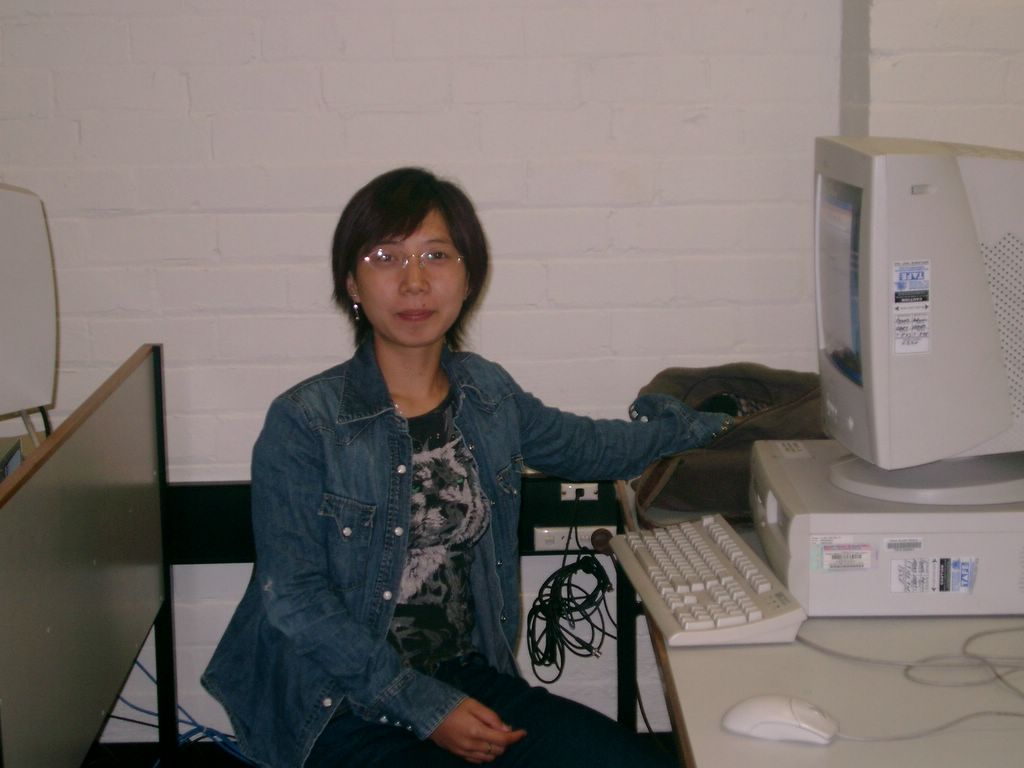
Hello, my name is Li Chen. I’m from China. I have been in Australia for 2 years and I’m currently doing an ESOL Level 4 course at TAFE. I studied English in China, but it is really different to doing it here. I’ll tell you more about it later.
I have met some very nice people in my ESOL class. We sometimes go out together on Fridays (I’ve got Fridays off!). One of my best classmates is Ana. Here she is!

Hi there. My name’s Ana. I’m Li’s classmate. I’m from Argentina. I met Li at TAFE. She has been here a lot longer than I have. I only came two months ago. I studied English at university, so they put me in the last ESOL level, but I don’t think I understand as much as Li does.
In this class we are learning many things, reading, writing, listening and speaking. But we are also learning many other things, like Australian Systems and Culture, pronunciation, and many other things.
We are now learning a module called
Approaches to Learning. We were given this quote as an introduction to Approaches to Learning:
“The most important learning of all- for both children and adults- is learning how to learn, the skills of self directed enquiry”
Knowles, M (1978) The Modern Practice of Adult Education” From Pedagogy to Andragogy. Chapter 4. ‘What is Andragogy?’. Prentice Hall, Inc, Englewood Cliffs. NJ.
This module is based on the TAFE curriculum for Certificate II in ESOL (English for Speakers of Other Languages). In it we are learning about how to study. I never thought that studying was different in different countries, but it can be.
Our teacher told us that learning is in part a personal experience. There are several ways in which a person learns: active learning, passive or receptive learning, reflective learning and critical learning. We can also do a lot of the learning individually, but we have to learn how to learn as part of a team. We also learn in a very specific environment (TAFE,so we have to become familiar with it to take advantage of everything it offers.
We are going to cover all these different ways of learning in three units or topics:
Topic 1: My Study Room (Personal Learning). (6 hours recommended) (it includes Critical Learning)
Topic 2: TAFE: classroom, library, ASC, counsellor’s unit (Learning in Context) (4 hours recommended)
Topic 3: Group work (Collaborative Learning) (4 hours recommended)
Topic 4: Smart learning (Critical thinking) ( 4 hours recommended)
This is the Assessment Grid (making the hidden curriculum explicit:LOS with assess tasks)
Learning Activity 1
Click on
Skills Assessment for Computer Based Learning. Have a play around. You will learn many things about computers.
Learning Activity 2
Do this exercise on computer language:
WeblangAssessment task: After doing Activities 1 & 2, you can open this survey on computer knowledge:
User profile doc. Copy it (save as) and fill it in. Then upload it or send it as an attachment. It will help your teachers know how much you know about computers. Then they will be able to help you better.
INTRODUCTION
Technical Requirements
What hardware and software do you require?
The minimum requirements are:
Module Content
What's this module about?
The purpose of this module is to help you learn about the way you learn, to apply individual and group learning strategies, to learn about the college and the classroom in which you study and to learn in a critical reflective way.
The module has 4 topics. These are:
Topic 1: My Study room. This unit is about personal learning. You will learn about time management, goal setting, learning styles and how to reflect about your learning.
Topic 2: College. We do not learn in isolation (by ourselves).We learn in a context. Our learning is done in a TAFE college, so you have to use the facilities your college provides to help your learning.
Topic 3: My Classroom. Learning is also a collaborative effort. Here you will think about the importance of learning as part of a group.
Topic 4: Smart Learning. Learning helps us become better thinkers. Here you will learn about critical thinking.
Timetable
Approaches to Learning is a module that you will be learning not only online, but also in class. The online part of it has been designed to be completed in 9 weeks, working 2 hours a week on it. However, different students will take different time to complete this module.
This table gives an indication of how much time to dedicate to each topic:
| Topic | Learning Field | Recommended hours | No Weeks
|
| 1. My Study Room | Personal Learning | 6 | 3
|
| 2. College | Learning in Context | 4 | 2
|
| 3. My Classroom | Collaborative Learning | 4 | 2
|
| 4. Smart Learning | Critical Learning | 4 | 2
|
Learning Outcomes & Assessment GuidelinesTo have a better idea of what you are going to learn in this module, you can read the Approaches to Learning 4
Learning Outcomes.
To have an overall idea of what you are learning in CESOL II, you can read the
Assessment Guidelines .Assessment grid: You will see what activities assess different Learning Outcomes.
You can print these three documents and file them in your folder. Once you finish reading them, tick the task icon (right hand corner)
Tasks
Each topic has several learning activities and assessment tasks. You should do all the learning activities. Some of the assessment tasks are compulsory (this means: you have to do them). Other assessment tasks are optional. You will be given a list of optional assessment tasks from which to choose the ones you feel more comfortable with, or you feel will teach you something new. You will be told how many optional tasks to complete for each topic.
Welcome
You can start working right now. Click here: Welcome to
Our Virtual Classroom and enjoy your learning.